Servo 0.0.5 is here, bringing with it lots of improvements in web platform features. Some highlights:
- <link rel=preload> (@TimvdLippe, @jdm, #40059)
- <style blocking> and <link blocking> (@TimvdLippe, #42096)
- <img align> (@mrobinson, #42220)
- <select disabled> (@simonwuelker, #42036)
- OGG files can now be played in <audio> (@jdm, #41789)
- ‘cursor-color’ (@mrobinson, #41976)
- ‘content: <image>’ works on all elements (@andreubotella, #41480)
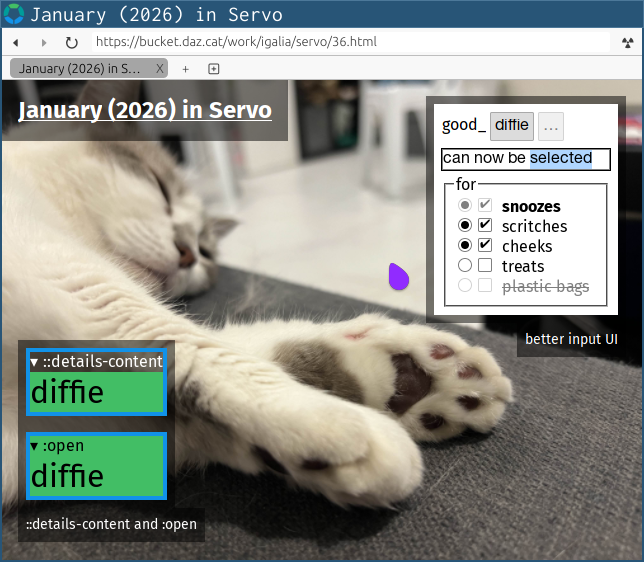
- ‘::details-content’ on <details> (@lukewarlow, #42107)
- ‘:open’ on <details> (@lukewarlow, #42195)
- ‘:active’ on <input type=button> (@mrobinson, #42095)
- Origin API (@WaterWhisperer, #41712)
- MouseEvent.detail (@mrobinson, #41833)
- Request.keepalive (@TimvdLippe, @WaterWhisperer, #41457, #41811)
- Cyclic imports, import attributes, and JSON modules (@Gae24, #41779)
- navigator.sendBeacon() is enabled by default (@TimvdLippe, #41694)
https_proxy,HTTPS_PROXY, andNO_PROXY(@Narfinger, #41689)- ML-KEM, ML-DSA, and AES-OCB in Crypto (@kkoyung, #41604, #41617, #41615, #41627, #41628, #41647, #41659, #41676, #41791, #41822, #41813, #41829)
Web APIs
Servo now plays OGG media inside <audio> elements (@jdm, #41789)! We disabled this feature many years ago due to bugs in GStreamer, our media playback engine, but those bugs have since been fixed.
We now support non-px sizes for width and height attributes in <svg> elements (@rodio, #40761).
Inactive documents will now correctly reject fullscreen mode changes (@stevennovaryo, #42068).
We’ve enabled support for the navigator.sendBeacon() by default (@TimvdLippe, #41694); the dom_navigator_sendbeacon_enabled preference has been removed.
As part of this work, we implemented the keepalive feature of the Request API (@TimvdLippe, @WaterWhisperer, #41457, #41811).
That’s not all for network-related improvements! Quota errors from the fetchLater() API provide more details (@TimvdLippe, #41665), and fetch response body promises now reject when invalid gzip content is encountered (@arayaryoma, #39438). Meanwhile, EventSource connections will no longer endlessly reconnect for permanent failures (@WaterWhisperer, #41651, #42137), and now use the correct ‘Last-Event-Id’ header when reconnecting (@WaterWhisperer, #42103). Finally, Servo will create PerformanceResourceTiming entries for requests that returned unsuccessful responses (@bellau, #41804).
There has been lots of work related to navigating pages and loading iframes. We process URL fragments more consistently when navigating via window.location (@TimvdLippe, #41805, #41834), and allow evaluating javascript: URLs when a document’s domain has been modified (@jdm, #41969). XML documents loaded in an <iframe> no longer inherit their encoding from the parent document (@simonwuelker, #41637).
We’re also made it possible to use blob: URLs from inside ‘about:blank’ and ‘about:srcdoc’ documents (@jdm, #41966, #42104).
Finally, constructed documents (e.g. new Document()) now inherit the origin and domain of the document that created them (@TimvdLippe, #41780), and we implemented the new Origin API (@WaterWhisperer, #41712).
Servo’s mixed content protections are steadily increasing. Insecure requests (e.g. HTTP) originating from <iframe> elements can now be upgraded to secure protocols (@WaterWhisperer, #41661), and redirected requests now check the most recent URL when determining if the protocol is secure (@WaterWhisperer, #41832).
<style blocking> and <link blocking> can now be used to block rendering while loading stylesheets that are added dynamically (@TimvdLippe, #42096), and stylesheets loaded when parsing the document will block the document ‘load’ event more consistently (@TimvdLippe, @mrobinson, #41986, #41987, #41988, #41973). We also fire the ‘error’ event if a fetched stylesheet response is invalid (@TimvdLippe, @mrobinson, #42037).
Servo now leads other browsers in support for new Web Cryptography algorithms! This includes full support for ML-KEM (@kkoyung, #41604, #41617, #41615, #41627), ML-DSA (@kkoyung, #41628, #41647, #41659, #41676), and AES-OCB (@kkoyung, #41791, #41822, #41813, #41829), plus improvements to AES-GCM (@kkoyung, #41950). Additionally, the error messages returned by many Crypto APIs are now more detailed (@PaulTreitel, @danilopedraza, #41964, #41468, #41902).
JS module loading received a lot of attention – we’ve improved support for cyclic imports (@Gae24, #41779), import attributes (@Gae24, #42185), and JSON modules (@Gae24, @jdm, #42138).
Additionally, the <link rel=preload> attribute now triggers preload fetch operations that can improve page load speeds (@TimvdLippe, @jdm, #40059).
IndexedDB support continues to make progress, though for now the feature is disabled by default (--pref dom_indexeddb_enabled).
This month we gained improvements to connection queues (@gterzian, #41500, #42053) and request granularity (@gterzian, #41933).
We were accidentally persisting SessionStorage data beyond the current session, but this has been corrected (@arihant2math, #41326).
Text input fields have received a lot of love this month. Clicking in an input field will position the cursor accordingly (@mrobinson, @jdm, @Loirooriol, #41906, #41974, #41931), as will clicking past the end of a multiline input (@mrobinson, @Loirooriol, #41909). Selecting text with the mouse in input fields works (@mrobinson, #42049), and double and triple clicks now toggle selections (@mrobinson, #41926). Finally, we fixed a bug causing the input caret to be hidden in <input> elements inside of Shadow DOM content (@stevennovaryo, #42233).
‘cursor-color’ is respected when rendering the input cursor (@mrobinson, #41976), and newlines can no longer be pasted into single line inputs (@mrobinson, #41934). Finally, we fixed a panic when focusing a text field that is disabled (@mrobinson, #42078), as well as panics in APIs like HTMLInputElement.setRangeText() that confused bytes and UTF-8 character indices (@mrobinson, #41588).
We also made time to improve form controls! The default styling of many controls received some care (@mrobinson, #42085), while <input type=button> can now be styled with the ‘:active’ pseudo-class (@mrobinson, #42095). Conversely, disabled <select> elements can no longer be activated (@simonwuelker, #42036).
Mouse events triggered by the embedder are more complete; MouseEvent.detail correctly reports the click count for ‘mouseup’ and ‘mousedown’ events (@mrobinson, #41833), and many other members are now consistent with other mouse events (@mrobinson, #42013).
Performing a pinch zoom on mobile is now reflected in the VisualViewport API (@stevennovaryo, #41754), though for now the feature is disabled by default (--pref dom_visual_viewport_enabled).
We’ve changed the behaviour of Web APIs that use the [Clamp] annotation (such as Blob.slice()).
The previous implementation would cast floating point values to their integer equivalents, but the standard requires more specific rounding logic (@Taym95, #41640).
The RGBA8 constant is now available in WebGL 1 rendering contexts; it was previously only available in WebGL 2 contexts (@simonwuelker, #42048).
Fonts were another area of focus this month. Loading web fonts from file: URLs works as expected (@TimvdLippe, #41714), as does using web fonts within Shadow DOM content (@minghuaw, #42151). Each web font request now creates a PerformanceResourceTiming entry (@lumi-me-not, #41784). Servo supports font variations as of November 2025, so as of this month, the FontFace constructor no longer ignores the ‘font-variation-settings’ property (@muse254, #41968).
Cursive scripts now ignore the ‘letter-spacing’ CSS property (@mrobinson, #42165), and we significantly reduced the time and memory required when rendering non-ASCII text (@mrobinson, @Loirooriol, #42105, #42162) and when text nodes share the same font (@mrobinson, #41876).
CSS
There were lots of improvements to block layout algorithms (@Loirooriol, #41492, #41624, #41632, #41655, #41652, #41683). These often affect pages where a block element (such as a <div>) exists within some other layout mode (such as an inline <span>, or a flexbox context), and fixes like these ensure Servo matches the output of other browsers.
Elements with scrollable overflow can be scrolled more consistently, even with CSS transforms applied to them (@stevennovaryo, #41707, #42005).
You can now use ‘content: <image>’ on any element (@andreubotella, #41480). Generated image content used to only work with pseudo-elements, but that restriction no longer applies.
<details> elements can now be styled with the ‘::details-content’ pseudo-element (@lukewarlow, #42107), as well as the ‘:open’ pseudo-class (@lukewarlow, #42195).
CSS styles now inherit correctly through ‘display: contents’ as well as <slot> elements in Shadow DOM content (@longvatrong111, @Loirooriol, @mrobinson, #41855).
‘overflow-clip-margin’ now works correctly when ‘border-radius’ is present (@Loirooriol, #41967).
We fixed bugs involving text inside flexbox elements: they now use consistent baselines for alignment (@lukewarlow, @mrobinson, #42038), and style updates are propagated to the text correctly (@mrobinson, #41951).
<img align> now aligns the image as expected (@mrobinson, #42220).
‘word-break: keep-all’ now prevents line breaks in CJK text (@RichardTjokroutomo, #42088).
We also fixed some bugs involving floats, collapsing margins, and phantom line boxes (@Loirooriol, #41812), which sound much cooler than they actually are.
Finally, we upgraded our Stylo dependency to the latest changes as of January 1 2026 (@Loirooriol, #41916, #41696). Stylo powers our CSS parsing and style resolution engine, and this upgrade improves support for parsing color functions like ‘color-mix()’, and improves our CSS animations and transitions for borders and overflow clipping.
Automation and introspection
Last month Servo gained support for HTTP proxies.
We now support HTTPS proxies as well (@Narfinger, #41689), which can be configured with the https_proxy or HTTPS_PROXY environment variables, or the network_https_proxy_uri preference.
In addition, the NO_PROXY environment variable or the network_http_no_proxy preference can disable any proxy for particular domains.
Our developer tools integration continues to improve. Worker globals are now categorized correctly in the UI (@atbrakhi, #41929), and the Sources panel is populated for very short documents (@atbrakhi, #41983). Servo will report console messages that were logged before the developer tools are opened (@eerii, @mrobinson, #41895). Finally, we fixed a panic when selecting nodes in the layout inspector that have no style information (@eerii, #41800).
We’re working towards supporting pausing in the JS debugger (@eerii, @atbrakhi, @jdm, #42007), and breakpoints can be toggled through the UI (@eerii, @atbrakhi, #41925, #42154). While the debugger is paused, hovering over JS objects will report the object’s properties for builtin JS classes (@eerii, @atbrakhi, #42186). Stay tuned for more JS debugging updates in next month’s blog post!
Servo’s WebDriver server is also maturing. Evaluating a synchronous script that returns a Promise will wait until that promise settles (@yezhizhen, #41823). ‘touchmove’ events are fired for pointer actions when a button is pressed (@yezhizhen, #41801), and ‘touchcancel’ events are fired for canceled pointer action items (@yezhizhen, #41937). Finally, any pointer actions that would trigger duplicate ‘mousemove’ events are silently discarded (@mrobinson, #42034).
Element Clear commands now test whether the element is interactable (@yezhizhen, #42124).
Now a null script execution timeout value will never trigger a timeout (@yezhizhen, #42184), and synthesized ‘pointermove’ events have a consistent pointerId value (@yezhizhen, #41726).
Embedding
You can now cross-compile Servo using Windows as the host (@yezhizhen, #41748).
We’ve pinned all git dependencies to specific revisions, to reduce the risk of build failures (@Narfinger, #42029). We intend to eventually forbid git dependencies in Servo libraries, which will help unblock releasing Servo on crates.io.
SiteDataManager now has a new clear_site_data() method to clear all stored data for a particular host (@janvarga, #41618, #41709, #41852).
Our nightly testing UI, servoshell, now respects any customized installation path on Windows (@yezhizhen, #41653). We fixed a crash in the Android app when pausing the application (@NiklasMerz, #41827). Additionally, clicking inside a webview in the desktop app will remove focus from any browser UI (@mrobinson, #42080).
We’ve laid more groundwork towards exposing accessibility tree information from webviews (@delan, @lukewarlow, @alice, #41924). There’s nothing to test yet, but keep an eye on our tracking issue if you want to be notified when nightly builds are ready for testing!
Stability & performance
We’ve converted many uses of IPC channels in the engine to channels that are more efficient when multiprocess mode is disabled (@Narfinger, @jdm, @sagudev, @mrobinson, #41178, #41071, #41733, #41806, #41380, #41809, #41774, #42032, #42033, #41412).
Since multiprocess mode is not yet enabled by default (--multiprocess), this is a significant boost to Servo’s everyday performance.
Servo now sets a socket timeout for HTTP connections (@Narfinger, @mrobinson, #41710).
This is controlled by the network_connection_timeout preference, and defaults to 15 seconds.
Each instance of Servo now starts four fewer threads (@Narfinger, #41740). Any network operations that trigger a synchronous UI operation (such as an HTTP authentication prompt) no longer blocks other network tasks from completing (@Narfinger, @jdm, #41965, #41857).
It’s said that one of the hardest problems in computer science is cache invalidation. We improved the memory usage of dynamic inline SVG content by evicting stale SVG tree data from a cache (@TomRCummings, #41675). Meanwhile, we added a new cache to reduce memory usage and improve rendering performance for pages with animating images (@Narfinger, #41956).
Servo’s JS engine now accounts for 2D and 3D canvas-related memory usage when deciding how often to perform garbage collection (@sagudev, #42180). This can reduce the risk of out-of-memory (OOM) errors on pages that create large numbers of short-lived WebGL or WebGPU objects.
To reduce the risk of panics involving the JS engine integration, we’re continuing to use the Rust type system to make certain kinds of dynamic borrow failures impossible (@sagudev, #41692, #41782, #41756, #41808, #41879, #41878, #41955, #41971, #42123). We also continue to identify and forbid code patterns that can trigger rare crashes when garbage collection happens while destroying webviews (@willypuzzle, #41717, #41783, #41911, #41911, #41977, #41984, #42243).
This month also brought fixes for panics in parallel layout (@mrobinson, #42026), WebGPU (@WaterWhisperer, #42050), <link> fetching (@jdm, #42208), Element.attachShadow() (@mrobinson, #42237), text input methods (@mrobinson, #42240), Web Workers when the developer tools are active (@mrobinson, #42159), IndexedDB (@gterzian, #41960), and asynchronous session history updates (@mrobinson, #42238).
Node.compareDocumentPosition() is now more efficient (@webbeef, #42260), and selections in text inputs no longer require a full page layout (@mrobinson, @Loirooriol, #41963).
Donations
Thanks again for your generous support! We are now receiving 7007 USD/month (−1.4% over December) in recurring donations. This helps us cover the cost of our speedy CI and benchmarking servers, one of our latest Outreachy interns, and funding maintainer work that helps more people contribute to Servo.
Servo is also on thanks.dev, and already 33 GitHub users (+3 over December) that depend on Servo are sponsoring us there. If you use Servo libraries like url, html5ever, selectors, or cssparser, signing up for thanks.dev could be a good way for you (or your employer) to give back to the community.
We now have sponsorship tiers that allow you or your organisation to donate to the Servo project with public acknowlegement of your support. A big thanks from Servo to our newest Bronze Sponsor: str4d! If you’re interested in this kind of sponsorship, please contact us at [email protected].
Use of donations is decided transparently via the Technical Steering Committee’s public funding request process, and active proposals are tracked in servo/project#187. For more details, head to our Sponsorship page.
Conference talks and blogs
There were two talks about Servo at FOSDEM 2026 (videos and slides here):
-
Implementing Streams Spec in Servo – Taym Haddadi (@taym95) described the challenges of implementing the Streams Standard.
-
The Servo project and its impact on the web platform – Manuel Rego (@rego) highlighted the ways that Servo has shaped the web platform and contributed to web standards since it started in 2012.